


IP54 vs IP65: What Water Resistance Means for Your Kit
You see IP54 or IP65 codes in controller and display specs, but you're not sure what they actually mean? Here's a plain-English breakdown of the difference and when it genuinely matters for your e-bike.
Contents
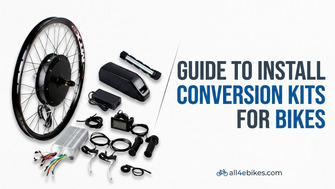
This guide is a companion to our complete e-bike conversion kit installation guide — the way you route and protect cabling during installation affects real-world water resistance just as much as the IP rating printed on the box. Worth reading once your kit is fitted, or before you order if you already know you'll be riding in all weather.
What an IP code actually means
The IP code (Ingress Protection) has two digits: the first shows protection against dust and solid particles (0-6), the second shows protection against water (0-9). The higher the digit, the better the protection.
- 5 — partial protection against dust
- 4 — protection against splashing from any direction
- Enough for light rain and moisture
- 6 — total protection against dust
- 5 — protection against low-pressure water jets
- Handles heavy rain better
| Rating | Dust | Water | Best for |
|---|---|---|---|
| IP54 | Partial protection | Splashing from any direction | Occasional commuting in light rain |
| IP65 | Total protection | Low-pressure water jet | Daily use regardless of weather |
The full IP rating scale, digit by digit
IP54 and IP65 are the two ratings you'll see most often on e-bike electronics, but they're just two points on a longer scale. Knowing what the other digits mean makes it easier to compare a spec sheet that quotes something slightly different, like IP44 or IP67.
| First digit (dust) | Protection level |
|---|---|
| 0 | No protection |
| 1–3 | Protection against large objects and limited dust |
| 4 | Protection against objects larger than 1mm |
| 5 | Dust protected — limited ingress permitted, doesn't affect operation |
| 6 | Dust tight — no ingress at all |
| Second digit (water) | Protection level |
|---|---|
| 0 | No protection |
| 1–3 | Dripping water and light spray only |
| 4 | Splashing water from any direction |
| 5 | Low-pressure water jets from any direction |
| 6 | Powerful water jets from any direction |
| 7 | Temporary immersion up to 1 metre |
| 8 | Continuous immersion beyond 1 metre — rarely relevant to e-bike parts |
| 9 | High-pressure, high-temperature water jets — rarely relevant to e-bike parts |
So IP54 reads as “partial dust protection, splash-proof,” and IP65 reads as “fully dust-tight, jet-resistant.” An IP67-rated component would additionally tolerate brief accidental submersion, though this is uncommon on conversion kit electronics and more typical of some sealed battery packs.
IP ratings are manufacturer specifications tested under controlled laboratory conditions, not independent field tests carried out by All4eBikes. They're a reliable guide to relative protection level, but real-world durability also depends on connector quality, how the cable is routed, and ordinary wear over time. Always check the specification sheet of the exact component you're buying rather than assuming every controller or display shares the same rating. For reference, the controllers (17A to 60A), the SW900 and UKC1+ displays and the batteries we sell are rated IP65.
How IP ratings are actually tested
IP ratings come from IEC 60529, an international standard that defines exactly how each digit is verified in a lab. It's worth knowing roughly what the test involves, since it explains both what the rating guarantees and what it doesn't.
- Dust digits (0–6) are tested in a sealed chamber with talc powder circulated by vacuum, for a fixed duration — digit 6 requires zero measurable ingress.
- Water digit 4 (splashing) is tested with an oscillating spray nozzle covering all angles for a set time, simulating rain and road spray from any direction.
- Water digit 5 (jets) steps up to a directed 6.3mm nozzle at defined pressure and distance for several minutes per square metre of surface — closer to a garden hose than a pressure washer.
The test is run once, on a new, undamaged sample, under controlled lab conditions. It doesn't account for years of vibration loosening a seal, a connector that's been unplugged and replugged repeatedly, or the effect of road salt over a winter. That's the practical reason a five-year-old IP65 controller with a slightly perished seal can behave more like an IP54 unit in practice — the rating describes the part as manufactured, not as it ages.
Real-world scenario guide
Putting the ratings into concrete riding situations makes the choice easier than working from the digits alone:
| Scenario | IP54 sufficient? | Notes |
|---|---|---|
| Occasional commute, checked forecast, light drizzle | Yes | Well within IP54's splash tolerance |
| Daily commute regardless of forecast | Borderline | Fine most days; IP65 removes the guesswork on the wet ones |
| Riding through standing puddles or flooded gutters | No | Depth and pressure can exceed splash-level protection; IP65 recommended |
| Washing the bike with a hose on a gentle setting | No | This is jet-level exposure — needs IP65 |
| Storing the bike outdoors under a simple cover | Yes, with care | Cover handles the bulk of exposure; either rating is fine if connectors are dry before storage |
| Riding fully exposed in heavy, sustained rain | No | IP65 strongly recommended, alongside the protective habits below |
Which kit components need protection
Not every part of a conversion kit is equally exposed. The most water-sensitive are:
- The controller — the central electronic component, most sensitive to moisture
- Electrical connectors — the junction points between cables are vulnerable to corrosion
- The display — directly exposed to rain while riding
The hub motor is usually better sealed by design thanks to its compact construction, but it's still worth checking before heavy use in rain.
How to protect your components regardless of IP rating
An IP rating describes the component in isolation, sealed at the factory. Once it's wired into your bike, the connectors joining it to the rest of the kit become the weakest point — and no printed rating covers those once you've made your own installation. A few habits meaningfully extend real-world reliability whatever rating your parts carry:
- Route cables with a drip loop so any water running down a cable passes below the connector rather than into it.
- Keep connectors away from direct wheel spray — mount the controller under the saddle or on the downtube rather than low near the rear wheel where possible.
- Use dielectric grease on connector pins before mating them; it displaces moisture and meaningfully slows corrosion over repeated wet rides.
- Dry the bike before long storage, particularly the display mount and any exposed connector joints, rather than leaving it wet in a shed overnight.
- Inspect connectors periodically for a greenish tint or white residue on the pins — early signs of corrosion that are easy to clean off with electrical contact cleaner if caught early, and much harder to fix once they've spread.
These steps matter more on a lower-rated IP54 setup, but they're worth doing on IP65 components too — a rating protects the sealed unit, not the connector you plugged into it yourself during installation.
What about battery water resistance?
E-bike batteries carry their own IP rating, separate from the controller and display, and it's arguably the component where getting it wrong has the most serious consequences — water ingress into a lithium battery pack is a genuine safety issue, not just a reliability one. Downtube and triangle battery cases are generally well-sealed by design since they're a permanent fixture rather than something you wire up yourself, but the charging port is the point worth checking: always confirm the port cover is seated properly after charging, and avoid charging a battery that's still wet from a ride.
Seasonal riding: does the season change what you need?
Summer commuting in occasional light rain rarely stresses IP54 components. Winter riding is a different case — road spray carries salt and grit that's more corrosive than plain rainwater, temperatures cause condensation inside housings as components warm and cool, and you're statistically more likely to ride through standing water or slush. If you ride through winter regardless of conditions, the case for prioritising IP65 components, or at minimum following the protective habits above religiously, gets noticeably stronger. The seasonal section of our e-bike maintenance guide covers the season-specific checks worth adding to your routine.
When the difference actually matters
IP54 is enough if...
- You ride occasionally, mostly in good weather
- You avoid intentionally riding through heavy rain
- You store the bike under cover when not in use
You want IP65 if...
- You commute daily regardless of weather
- You frequently cross puddles or wet roads
- You wash your bike with a hose more often
Tell us how and how often you ride — we'll help you pick the right components for your actual conditions.
Ask the All4eBikes team →Frequently asked questions about water resistance
What does IP54 mean?
IP54 means partial protection against dust (digit 5) and protection against water splashed from any direction (digit 4). It's enough for light rain and moisture, but not for submersion or a strong water jet.
What does IP65 mean?
IP65 means total protection against dust (digit 6) and protection against low-pressure water jets from any direction (digit 5). It's a higher level than IP54 and offers better protection in heavy rain.
Do I need IP65, or is IP54 enough for normal use?
For most riders who ride occasionally in light rain, IP54 is enough. IP65 becomes relevant if you ride daily regardless of weather, cross puddles frequently, or rinse your bike with a gentle hose. High-pressure washing is not covered even by IP65.
Which parts of a conversion kit need water resistance?
The most exposed parts are the controller, electrical connectors and the display. The hub motor is usually better sealed by design, but the controller and connectors are the critical points to check before riding in rain.
What happens if I use a kit without adequate IP protection in the rain?
Water can get into the controller or connectors and cause short circuits, corrosion, or intermittent operation. If you know you'll ride in rain often, always check the IP specifications of components before buying.
Does an IP65 rating mean I can hose the bike down or ride through deep puddles?
Not fully. IP65 covers low-pressure water jets from any direction, not high-pressure washing or submersion. A garden hose on a gentle setting from a reasonable distance is generally fine; a pressure washer or riding through water deep enough to submerge the controller is beyond what IP65 is designed to handle.
Is the battery's water resistance the same as the controller's?
Not necessarily — each component carries its own rating. Battery packs are usually well-sealed as a permanent unit, but the charging port is a specific point worth protecting: avoid charging a battery that's still wet, and confirm the port cover is properly seated after each charge.
Does riding in winter require a higher IP rating than summer?
Not strictly required, but it's a reasonable upgrade to prioritise. Winter road spray carries salt and grit that's more corrosive than plain rainwater, and standing water or slush is harder to avoid. If you ride through winter regardless of conditions, IP65 components plus consistent connector maintenance make a bigger difference than in summer-only use.
Conclusion: choose based on use, not the bigger number
There's no universal "IP65 is always better" answer — it depends on how and how often you ride. For occasional commuting in good weather, IP54 is enough. If you ride daily regardless of weather, invest in IP65 components.
What matters more than chasing the highest number on the spec sheet is matching the rating to how you actually use the bike, and following sensible cable-routing and connector-care habits regardless of which rating you land on. A well-installed IP54 setup that's kept dry and well-maintained will often outlast a neglected IP65 one.
Have questions about a specific accessory's specs? Contact us before ordering.
Reviews