


Hub Motor vs Mid-Drive: Which Is Better?
The most common question before buying an e-bike conversion kit. The answer depends on how and where you ride — there's no universal winner.
Contents
What each system means
When you convert a bike into an e-bike, the first major technical decision is the motor type. A hub motor mounts directly into the wheel hub — most commonly the rear wheel — and pushes the bike independently of the drivetrain. A mid-drive motor mounts at the bottom bracket, the bike's central pivot, and sends power through the existing chain and cassette.
This difference in placement fundamentally changes how each system works, how it feels to pedal, and what costs it implies long-term. Let's go through both.
Hub motor: simplicity and direct power
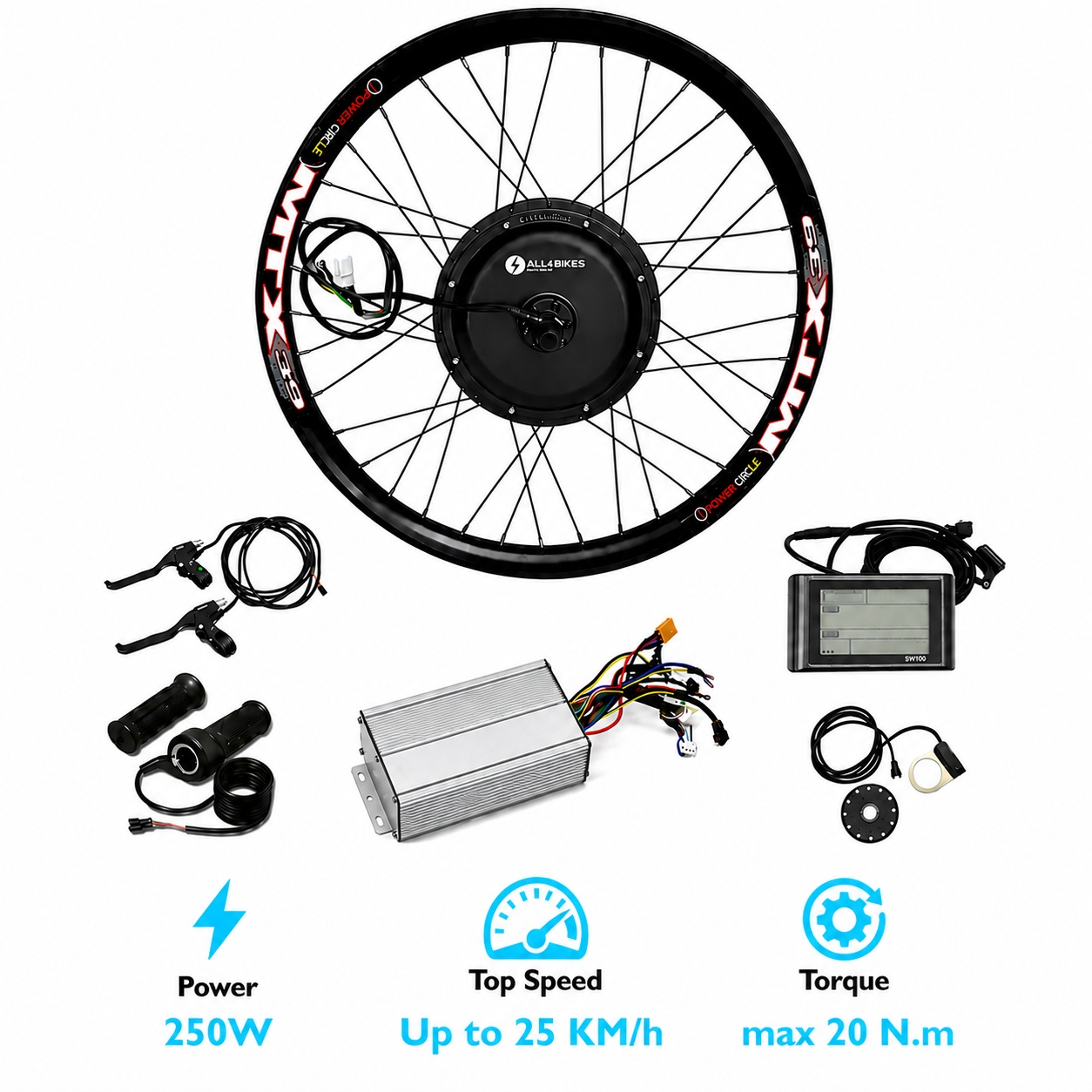
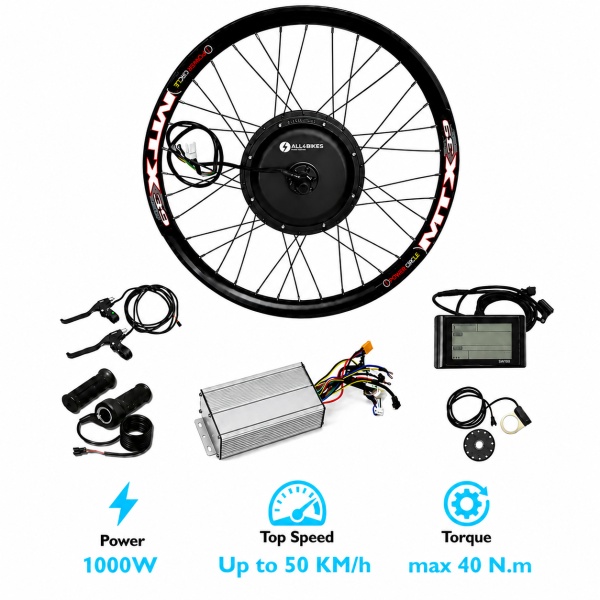
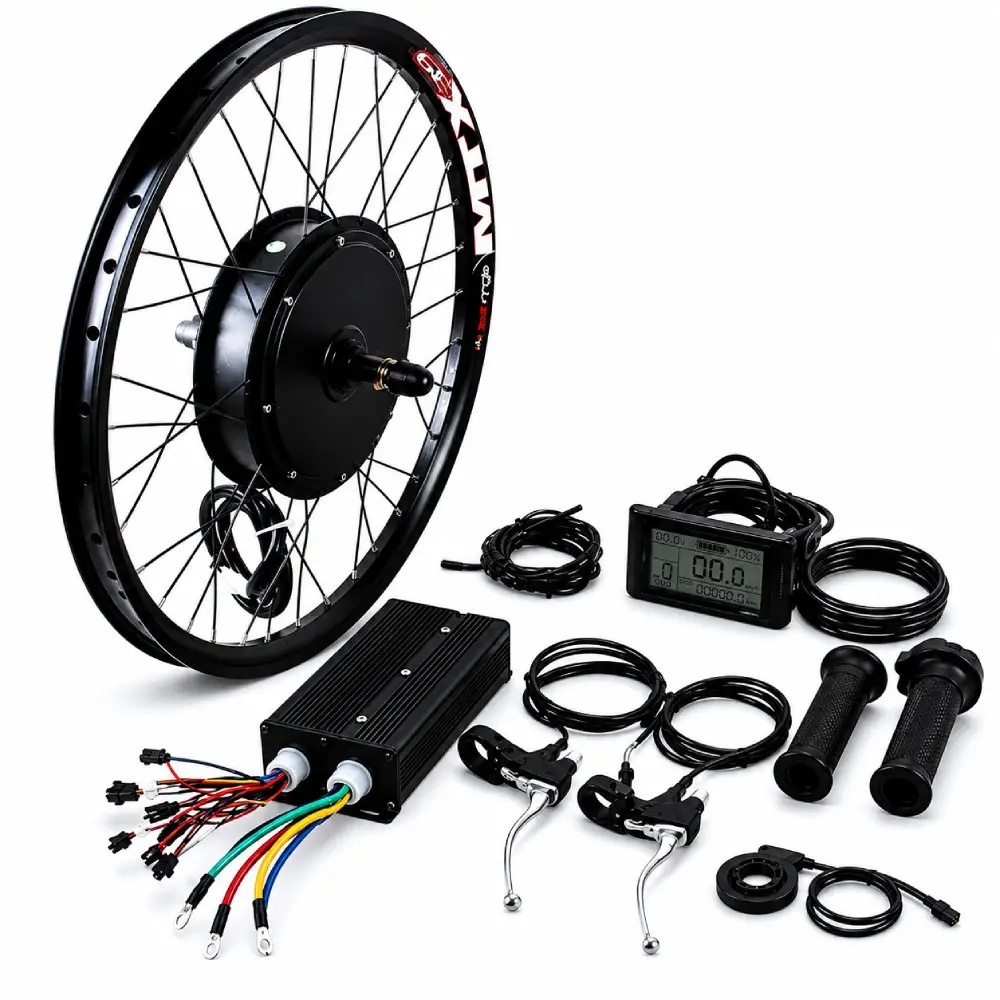
A hub motor is an electric motor encapsulated inside the wheel hub. There are no visible intermediate mechanical components: the motor spins, the wheel spins, the bike moves. This simplicity is its biggest advantage.
How it works technically
The stator coils are fixed inside the motor, while the permanent magnets on the rotor spin around them. The controller modulates current through the coils to produce the rotating magnetic field that drives the wheel. The brushless design eliminates mechanical wear and reduces noise to nearly zero. Geared hub motors add a planetary reduction that lets the motor run at higher internal RPM, amplifying the torque available at the wheel.
Advantages of a hub motor
- Simple installation: swap the rear wheel, connect 3–4 cables, mount the battery and controller — in 2–3 hours, no special tools.
- Minimal maintenance: doesn't stress the drivetrain. Chain and cassette wear at a normal rate.
- Affordable cost: hub kits are significantly cheaper than mid-drives of equivalent nominal power.
- Quiet operation: direct-drive motors are virtually silent at any speed.
- High power available: hub motors reach 1500W, 2000W, or even 3000W — power levels at which standard commercial mid-drives don't exist.
- Regenerative braking: direct-drive hub motors can recover energy under braking.
- Full redundancy: if the battery dies, you can pedal normally without significant added resistance.

Limits of a hub motor
The main weakness of a hub motor is that it operates isolated from the bike's drivetrain. No matter what gear you're in, the motor delivers the same torque to the wheel. On steep climbs, this means higher current draw, faster overheating, and reduced range compared to a mid-drive that could take advantage of a low gear.
At high power — 1000W or above — geared motors can overheat on long climbs if you don't let your legs contribute. Practical solution: keep assistance at 50–70% on long climbs and pedal actively.
Once you've picked hub, the next question is front or rear
Deciding on a hub motor is only half the decision. A hub motor can be laced into either the front or the rear wheel, and the two positions are not interchangeable above 500W. The rear wheel naturally carries 60–65% of total rider and bike weight, which gives it far better traction under power and is why every All4eBikes MTX conversion kit ships as a rear hub motor. A front hub motor is structurally capped at roughly 500W because the fork and dropout aren't built to absorb higher torque. We break down the physics, the safety limits, and the one legitimate use case for a front motor in our dedicated guide, front hub motor vs rear hub motor.
Mid-drive motor: efficiency through the drivetrain
A mid-drive places the motor at the bottom bracket and sends force through the bike's chain. The fundamental advantage: the motor benefits from all the bike's gears, just like your pedaling does.
Why the drivetrain makes the difference
Imagine climbing a steep hill. On a regular bike, you shift to a lower gear to multiply torque at the wheel. A mid-drive does exactly the same thing with electric power — the motor runs at its optimal internal RPM while the drivetrain handles the terrain adaptation. The result: less consumption, a cooler motor, and stronger climbing than any hub motor of similar nominal power. A well-built 750W mid-drive can produce over 100–160Nm of effective torque at the wheel — a figure no hub motor of similar nominal power can match, precisely due to the drivetrain multiplication.
Mid-drive availability at All4eBikes
Mid-drive systems are in the process of being added to the All4eBikes range. Once available, you'll find options with a torque sensor, programmable through standard communication protocols with the battery and display, sized for performance builds and rough terrain.
We're working on expanding our range with mid-drive systems for e-bike conversions. In the meantime, our hub motor range covers power levels from 250W to 3000W, with free shipping in Romania.
Let me know when it's available →Disadvantages of mid-drive
- Higher price: a mid-drive kit of comparable power typically costs 2–3 times more than an equivalent hub motor.
- Drivetrain wear: at high torque, the chain, cassette, and chainrings wear out considerably faster. Periodic replacement is required.
- More complex installation: you need to remove the bottom bracket and check bottom bracket shell compatibility (68–73mm BSA/JIS).
- Limited compatibility: carbon frames, thru-axles, or unusual geometries may be incompatible without adapters.
- Shifting under power: shifting gears at maximum motor power rapidly damages the drivetrain.
Pedaling feel: why the sensor matters as much as the motor
Motor placement decides how power reaches the wheel, but a second, often overlooked component decides how that power is triggered: the pedal sensor. Hub motor kits — including every MTX kit at All4eBikes — are paired with a cadence sensor (PAS). It detects that your pedals are turning and delivers a fixed level of assist, regardless of how hard you're actually pushing. It's simple, reliable, and inexpensive, but the assist can feel slightly "on/off" — a short delay, then a constant push.
Premium mid-drive systems are usually paired with a torque sensor instead. It measures the actual force on the pedals in real time and scales assistance proportionally — pedal lightly and the motor helps a little, push hard on a climb and it responds in kind. This is a large part of why mid-drive motors feel more "natural" than hub motors, independent of the torque multiplication from the gears. If the pedaling feel itself is the deciding factor for you, not just raw power or price, read our detailed breakdown in cadence sensor vs torque sensor.
Side-by-side comparison
| Criterion | Hub Motor | Mid-Drive |
|---|---|---|
| Complete kit price | 250W–3000W, check all4ebikes.com | Variable, generally higher |
| Installation difficulty | Easy (2–3 hours) | Medium (4–6 hours) |
| Torque at the wheel | Medium–High | Very high (100Nm+) |
| Climbing performance | Good (at high power) | Excellent (uses the gears) |
| Battery efficiency | Good on flat terrain | Superior on varied terrain |
| Drivetrain wear | Minimal | High (periodic maintenance) |
| Pedaling feel | Consistent assistance | Natural (torque sensor) |
| Frame compatibility | 135 mm QR rear axle (no thru-axle) | Limited (68–73mm BSA BB) |
| Weight distribution | Rear wheel | Low-central (balanced) |
| Regenerative braking | Yes (direct drive) | No |
| Maintenance | Minimal | Periodic |
| Maximum power available | 250W → 3000W, in stock | 250W → 1000W (coming soon) |
When to choose hub, when to choose mid-drive
🔵 Choose a hub motor if:
- You want fast installation without major modifications to the bike
- Budget is a priority — you want the best power-to-price ratio
- You mostly ride flat terrain or moderate climbs
- You want high power (1500W–3000W) for cargo or performance builds
- Your bike has a standard 135 mm quick-release rear axle (MTX kits don't fit thru-axles, and the included torque arms are not compatible with carbon frames)
- You want to minimize chain and cassette wear
- This is your first conversion and you want to learn the system step by step
🔴 Choose mid-drive if:
- You ride rough terrain with frequent, consistent climbs
- You want the most natural pedaling feel with a torque sensor
- Battery range is the priority — you cover long distances daily
- You have a quality mountain or trekking bike that deserves a premium motor
- You want a programmable system, tunable exactly to your parameters
- You're willing to invest more upfront for superior performance
Real-world scenarios: 4 riders, 4 verdicts
Specs and tables are useful, but most people decide faster once they see themselves in a scenario. Here's how the choice plays out for four common rider profiles.
The daily rider on flat terrain
You ride 8–15 km each way on tarmac, mostly flat, with the occasional bridge or underpass ramp. A 250W or 500W hub motor is the correct call. Installation is a weekend job, the drivetrain sees no extra wear from years of daily riding, and the total cost stays low. A mid-drive would be technical overkill here — you'd be paying a premium for climbing performance you rarely use.
The weekend rider with a hilly loop
Your regular route has one or two sustained climbs in the 6–10% grade range. This is the genuine gray zone. A 1000W hub motor handles this comfortably if you're willing to pedal along and keep assist around 50–70% on the climbs. A mid-drive would climb more efficiently and use noticeably less battery per ride, but the price difference has to be worth it to you for a route you ride once or twice a week.
The cargo or heavy-load rider
You're hauling groceries, a child seat, or using the bike for light delivery work, often on mixed terrain. This is squarely hub motor territory — specifically 1000W or higher. Mid-drive systems concentrate enormous stress on the chain and cassette under sustained heavy load, which means much faster wear and more frequent drivetrain replacement — exactly the wrong trade-off when the bike is working hard every day.
The trail rider on a quality hardtail or full-suspension MTB
You ride singletrack with frequent elevation changes and want the bike to feel as close as possible to an unassisted MTB, just easier on the climbs. This is where mid-drive's low-central weight placement and torque-sensor feel matter most, and where the investment is easiest to justify on a bike that already represents a serious investment. Until mid-drive lands in the All4eBikes range, a well-configured 1000W–1500W rear hub motor remains the practical option, with assist dialed back on technical singletrack to preserve control.
Cost over 3 years: hub vs mid-drive
Sticker price is only part of the real cost. Drivetrain wear, part replacement, and charging add up differently for each system over time.
| Cost factor | Hub Motor | Mid-Drive |
|---|---|---|
| Initial kit price (500W–750W class) | Lower | 2–3× higher |
| Chain replacement interval | Normal wear, ~2,500–4,000 km | Faster, ~1,000–2,000 km under load |
| Cassette / chainring wear | Minimal extra stress | Accelerated, especially at high torque |
| Battery cost to replace | Similar across formats at same voltage | Similar across formats at same voltage |
| Motor rebuild / bearing service | Rare, sealed unit | Possible, more moving parts under load |
| Electricity cost per charge | Comparable at equal battery size | Slightly lower per km (efficiency) |
| DIY serviceability | High — swap wheel, done | Lower — bottom bracket work needs more skill |
In practice, a hub motor build on a bike used daily or for moderate use tends to stay cheaper over three years even accounting for the slightly lower per-km efficiency, simply because the upfront cost gap is large and drivetrain parts are inexpensive to replace on a hub-driven bike since they wear at a normal rate. Mid-drive starts to close that gap only on bikes ridden hard, daily, on hilly terrain, where the efficiency and climbing advantage translate into real range and comfort gains that are used every single ride.
The right battery for each system
Regardless of the motor type you choose, the battery is just as important as the motor. A 1000W motor powered by an undersized battery will perform poorly and drastically reduce cell lifespan.
Practical recommendations for All4eBikes hub motor kits:
- 250W: 36V 15Ah is sufficient. Estimated range of 55–65 km under normal conditions.
- 500W: 48V 17.5Ah recommended. Estimated range of 60–80 km.
- 1000W: 48V 22.5Ah required. Below this, the battery discharges quickly at maximum power.
- 3000W: 52V 20Ah+ or 72V 20Ah minimum for better efficiency.
Explore the complete range of e-bike batteries from All4eBikes — downtube and triangle, compatible with 36V, 48V, 52V, and 72V, with a 12-month warranty and free shipping in Romania over 500 RON.
Frequently asked questions
Which motor uses less battery, hub or mid-drive?
Mid-drive is more energy efficient on varied terrain because it uses the bike's gearbox. On flat, consistent terrain, a good quality hub motor can be just as efficient. The difference becomes significant on long climbs or with frequently changing speeds — in these conditions, mid-drive can offer 20–30% more range.
Can I install a hub motor conversion kit myself?
Yes. All4eBikes hub motor kits install in 2–3 hours with no special tools: swap the rear wheel, connect the cables to the controller and battery, mount the PAS sensor and the display on the handlebar. Check our installation guide on the blog for detailed steps.
What does UART vs CAN-BUS mean on mid-drive motors?
UART is the classic serial protocol — simple, widely compatible with third-party displays and programming cables, ideal for DIY builders who want maximum flexibility. CAN-BUS is the modern protocol with advanced bidirectional communication: you can see battery temperature, charge cycles, and cell status directly on the display screen. UART for flexibility; CAN-BUS for full integration with the motor's ecosystem.
What wheel size — 26in, 27.5in, or 29in — fits the hub motor?
All4eBikes hub motor kits are available in 26in, 27.5in and 29in depending on power: the 500W kit comes in 27.5in and 29in, the 3000W kit in 26in and 27.5in, and the others in all three. 26in gives sharper torque off the start — ideal for quick starts and cargo use. 27.5in is the most balanced for mixed and hybrid terrain. 29in rolls smoother at high speeds and clears obstacles more easily — ideal for trail and long-distance touring.
Will mid-drive motors be compatible with any bike frame?
Not exactly. Mid-drive motors typically require a 68–73mm wide bottom bracket shell with BSA/JIS threading — the most common standard on aluminum and steel frames. Carbon frames, thru-axles, press-fit, or unusual geometries may be incompatible without specific adapters. Always check your bottom bracket specifications before ordering, once the mid-drive range becomes available.
Does a hub motor make climbing impossible on hills?
No, but it changes how you climb. Since a hub motor delivers the same torque to the wheel regardless of gear, you compensate by pedaling actively and keeping assist around 50–70% rather than maxing it out, which also prevents overheating on long climbs. The MTX 1000W kit is specified for sustained climbing on 5–20% grades; on steeper or very long climbs, a mid-drive's gear multiplication becomes the more efficient tool.
How long does it take to install a hub motor conversion kit?
Typically 2–3 hours: swap the wheel, connect 3–4 cables, then mount the battery and controller. A hub motor leaves your drivetrain untouched, which is why it is quicker than a mid-drive that needs bottom bracket work (4–6 hours). See our hub motor conversion kits to pick your power level.
Can I switch a hub motor kit from one bike to another later?
Yes, this is one of the practical advantages of a hub motor build. Since the motor lives in the wheel and the controller, battery and display are separate components connected by standard connectors, the whole kit can be removed from one bike and reinstalled on another with a compatible frame and dropout width. A mid-drive is more bike-specific once installed, since it's tied to the bottom bracket shell dimensions of that particular frame.
Conclusion
Hub motor vs mid-drive isn't a competition with a single winner. It's a personal choice based on terrain, budget, and riding style.
If you want simplicity, raw power, and lower cost — All4eBikes hub motor kits from 250W to 3000W are the clear solution, in stock now, with free shipping in Romania. If you want maximum efficiency, a natural feel, and mountain performance — mid-drive systems are in the process of being added to our range.
Have questions about compatibility with your bike? Contact us before buying — our team can recommend exactly the type and power that fit your situation.
Reviews