


Front Hub Motor vs Rear Hub Motor: Which Position Wins?
Front wheel or rear wheel motor — it sounds like a minor detail, but the effect on traction, stability, maximum power and installation complexity is fundamentally different. This guide shows you exactly what matters before you choose.
Contents
How they work: what is actually different
Both types use the same brushless hub motor technology — the difference is not in the motor itself, but in which wheel it is integrated into and the mechanical consequences of that choice. A front hub motor drives the front wheel; a rear hub motor drives the rear wheel — the same distinction as front-wheel drive versus rear-wheel drive in a car.
This position difference produces distinct effects on traction, acceleration behaviour, weight distribution and the maximum power rating that is structurally safe to use. It is not a matter of personal preference — it is a technical decision with clear, predictable consequences.
This guide assumes you've already settled on a hub motor as your conversion type. If you're still deciding between a hub motor and a mid-drive motor in the first place, read our comparison of hub motor vs mid-drive before coming back here to settle on front or rear placement.
Traction: why rear always wins on real terrain
Traction is the ability of the drive wheel to transfer motor power into actual movement without slipping. On a bicycle, the rider's weight and bike weight distribute roughly 60–65% to the rear wheel. This natural rear loading is exactly what gives a rear hub motor its traction advantage in almost every real-world condition.
A front hub motor drives a wheel that naturally carries only 35–40% of the total weight. Under sharp acceleration or on slippery surfaces — wet gravel, mud, damp tarmac — the front wheel tends to break traction and spin, especially at powers above 250W.
On dry, flat tarmac the difference is less noticeable. On hills, wet terrain or in corners under acceleration, the difference becomes critical.
Power limit: why the front motor stops at 500W
This is the most important technical criterion and the most frequently overlooked. A front hub motor is structurally limited to a maximum of 500W. This is not a convention — it is a hard limit imposed by the front fork and standard dropout design.
Why you cannot run 1000W on the front wheel
At 1000W, a hub motor produces up to 40 N.m of torque (the MTX 1000W kit's rating). The front fork on most bicycles — including MTB rigid forks — is designed to handle vertical forces (weight, vibration), not rotational forces of this magnitude applied to the wheel axle. The potential consequences of a 1000W motor on the front wheel include:
- Axle spin in the dropout — the motor axle rotates within the fork dropout if clamping is insufficient; produces sparks, damages the fork and can release the wheel while riding
- Fork failure — especially on thin aluminium forks or suspension forks, the combined torque and vibration can crack the material at the dropout
- Loss of steering control — sudden motor reaction at hard acceleration can rotate the handlebars involuntarily
All serious conversion kit manufacturers limit front wheel motors to 250W–500W. At All4eBikes, every MTX conversion kit is configured with a rear hub motor precisely for this reason — it is the only motor position that allows safe power scaling up to 3000W.
What actually happens under power: wheel spin and controller response
When a hub motor draws current under hard acceleration, the wheel it's mounted to needs enough downward force — traction — to convert that torque into forward motion instead of spin. On a rear motor, the rider's own weight shifts further back under acceleration, adding even more load to the driven wheel at exactly the moment it needs it most. This is a self-reinforcing effect: harder acceleration means more rearward weight transfer, which means more grip, which allows the motor to actually use its power.
A front motor experiences the opposite dynamic. Under acceleration, weight transfers away from the front wheel, reducing the exact traction the motor needs precisely when demand is highest. This is why front-hub wheel spin often shows up suddenly, on wet cobblestones or loose gravel, in a way that catches new riders off guard — the bike behaves normally at cruising speed, then the front wheel breaks loose the moment you twist the throttle hard from a stop.
Most controllers include a soft-start or ramp-up curve that limits how quickly current rises when you first apply throttle or pedal assist, partly to protect the drivetrain and partly to reduce exactly this kind of traction loss. On a rear motor this ramp mostly matters for rider comfort. On a front motor it is doing real safety work, which is one more reason front motors are kept to modest power levels even when a controller theoretically supports more.
Installation: where the front motor has an edge
The one concrete advantage of a front hub motor is installation simplicity. The front wheel has no cassette, freewheel, derailleur or chain — replacing it with a motor wheel takes 15–20 minutes with no specialist tools. The motor cable runs directly to the controller without passing through the drivetrain area.
With an MTX kit you do not move your old cassette or freewheel: the kit includes a 7-speed freewheel (1.375" x 24 TPI thread) that you screw onto the motor hub during installation. It is one extra step compared with a front wheel, but it needs no special tools and quickly becomes routine.
| Criterion | Front Hub Motor | Rear Hub Motor |
|---|---|---|
| Traction on dry terrain | Good | Excellent |
| Traction on wet terrain / hills | Poor (wheel spin) | Superior |
| Maximum safe power | 500W max | 250W – 3000W |
| Installation difficulty | Very simple (15 min) | Simple (freewheel included in the kit) |
| Drivetrain involvement | No cassette removal needed | Included 7-speed freewheel fitted to the motor hub |
| Weight distribution | Loads the front fork | Adds weight to drive wheel (better traction) |
| Riding feel | Motor "pushes" from front | Natural, like a standard bike |
| Suspension fork compatibility | Problematic above 250W | Fully compatible |
| Motor visibility | Motor visible on front wheel | Discreet, integrated at rear |
| Structural safety | Limited to 500W | Safe to 3000W |
| Suitable for hills above 10% | No | Yes |
| Price at equivalent power | Similar | Similar |
Recommended kits: rear motor for every power level
Every MTX kit available on all4ebikes.com is configured with a rear hub motor. This is not a product range limitation — it is a deliberate technical decision: the rear motor delivers superior traction, compatibility with any power level and long-term structural safety regardless of bike type or terrain.
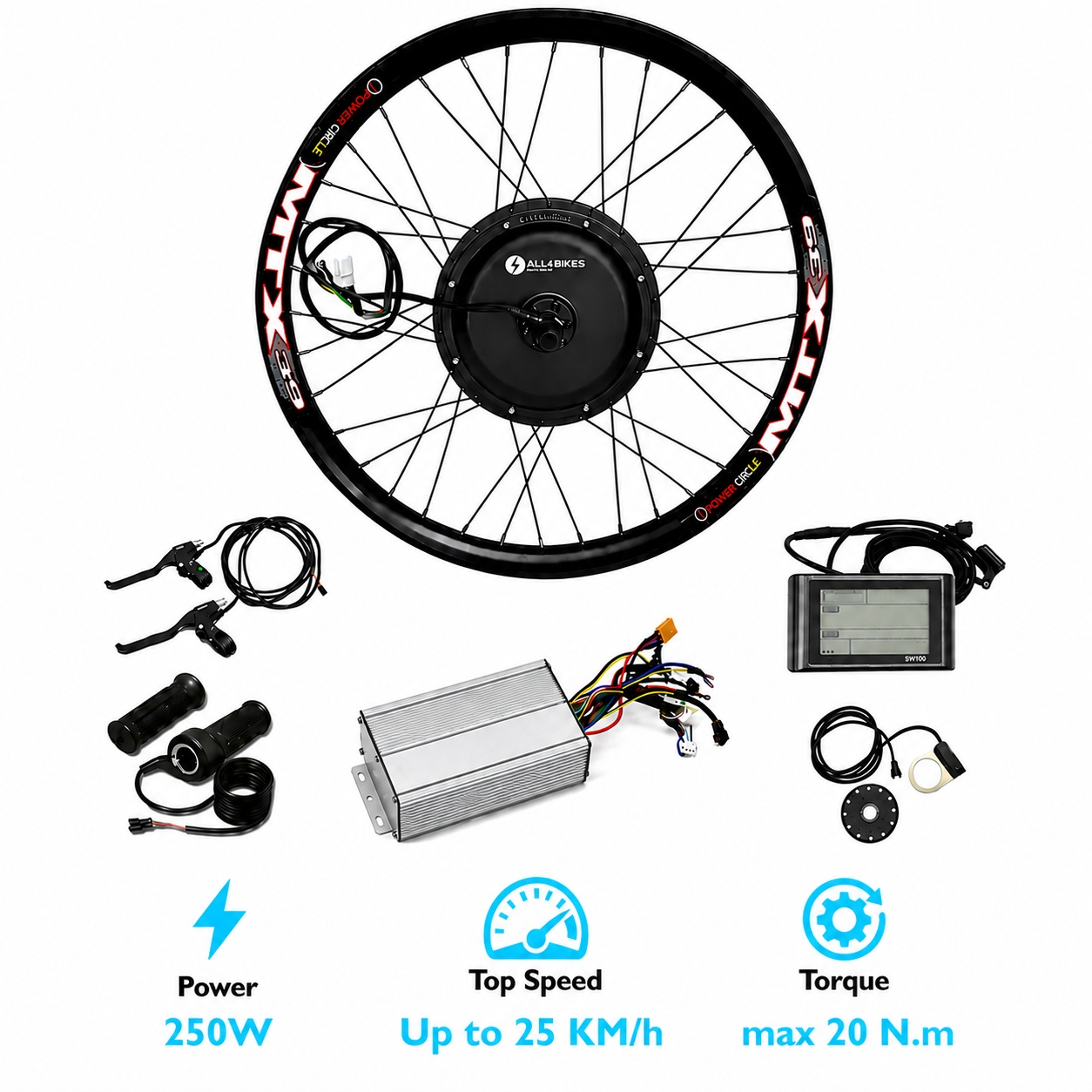

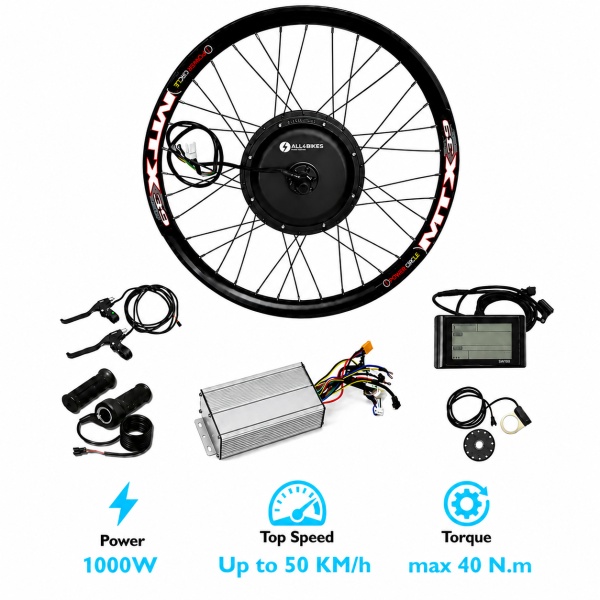
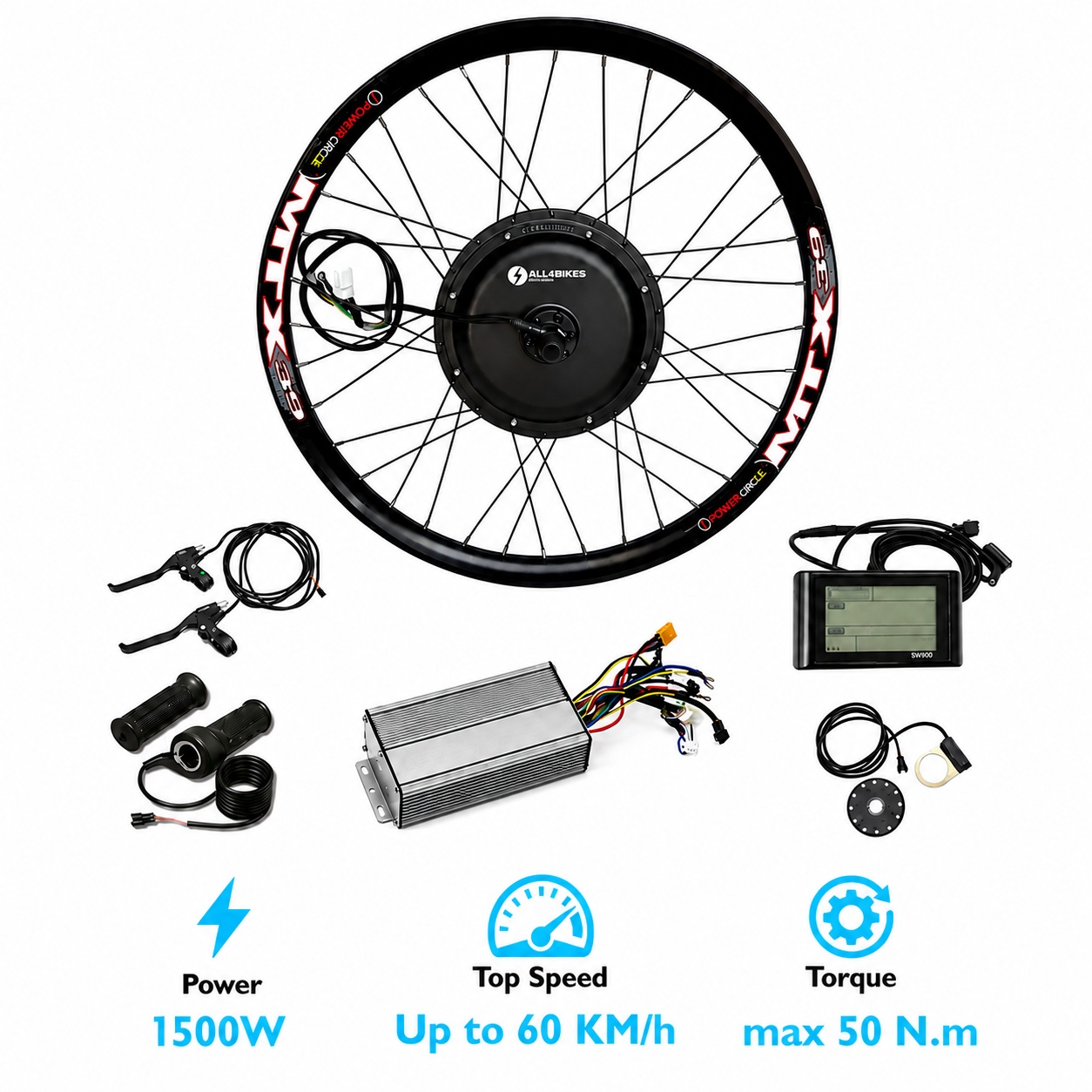
High-power kits: rear motor only
From 1000W upward, the choice is no longer a decision — the rear motor is the only technically viable option. The 1000W, 1500W, 2000W and 3000W MTX kits are built specifically for rear wheel mounting and deliver torque and power at a level no front fork can safely sustain.
Matching battery capacity to motor position and power
Whichever position you settle on, the motor is only half the build — the battery has to be sized correctly or you'll see poor performance and shortened cell lifespan regardless of how good the motor is. As a rough guide for rear hub kits: a 250W–500W build is comfortable on 36V 15Ah or 48V 17.5Ah, a 1000W build needs at least 48V 22.5Ah to avoid heavy voltage sag under load, and 1500W and above call for 52V 20Ah or higher to keep current draw within a comfortable margin. Front hub builds, being capped at 500W, rarely need anything beyond a 36V or 48V mid-capacity pack, since the motor itself will never draw enough current to stress a larger battery.
Use cases: when each motor position makes sense
While we recommend the rear motor for virtually every situation, there is one scenario where a front motor is a rational choice: a bicycle with complex drivetrain components you do not want to disassemble, used exclusively on flat, dry urban terrain at low power.
Front motor — the one justified use case
- Maximum desired power: 250W or 500W (exclusively)
- Flat, dry urban use only — no significant gradients
- Bike with complex drivetrain (IGH, Gates belt) where cassette removal is complex
- Temporary installation or quick test without long-term commitment
- You accept the traction limitations on wet or uneven terrain
Rear motor — recommended in every other situation
- Any power level from 250W to 3000W — the only option above 500W
- Mixed terrain, hills, off-road or wet conditions
- You want natural traction feel and predictable acceleration behaviour
- Building an e-bike for daily use, not occasional rides
- Long-term structural reliability without fork concerns
- Compatibility with hydraulic disc brakes and suspension forks
Common installation mistakes to avoid
Most front-vs-rear problems people report after a conversion trace back to a handful of avoidable mistakes at install time, not the motor position itself.
- Under-torquing the axle nuts on either wheel. Hub motor axles are flat, not round, and rely on correct clamping force in the dropout to stay put. A loose axle nut lets the motor spin in the dropout under load — on a front fork this is a genuine safety issue, not just an annoyance.
- Forgetting the anti-rotation washers/torque arms on high-power rear builds. Every MTX kit includes two torque arms with clamps; fit both. On 1000W+ rear kits, a torque arm bolted to the frame stay takes pressure off the dropout itself and prevents slow axle creep over months of use.
- Reusing an old, stretched chain with a new rear motor wheel. Whenever you install a rear hub motor, it's worth checking chain wear at the same time — a stretched chain under new torque wears the cassette faster than normal.
- Skipping the brake cut-off sensor wiring. Both front and rear kits include brake levers with motor cut-off sensors; skipping this step means the motor can keep pushing while you're braking, which is avoidable and unsafe.
- Trying to move your old cassette onto the motor wheel. MTX motor hubs take a threaded freewheel (1.375" x 24 TPI), not a freehub cassette. Use the 7-speed freewheel included in the kit: 8 to 12-speed cassettes will not fit the motor hub.
All MTX kits: power levels and wheel sizes
| MTX Kit | Motor position | Wheel size | Price |
|---|---|---|---|
| 250W MTX Kit | Rear hub | 26in / 27.5in / 29in | Check current price → |
| 500W MTX Kit | Rear hub | 27.5in / 29in | Check current price → |
| 1000W MTX Kit | Rear hub | 26in / 27.5in / 29in | Check current price → |
| 1500W MTX Kit | Rear hub | 26in / 27.5in / 29in | Check current price → |
| 2000W MTX Kit | Rear hub | 26in / 27.5in / 29in | Check current price → |
| 3000W MTX Kit | Rear hub | 26in / 27.5in | Check current price → |
The complete 250W–3000W range available on all4ebikes.com. Every kit includes the motor wheel, controller, SW900 LCD display, twist throttle, brake levers with cut-off sensor, two torque arms, a 7-speed freewheel and the full wiring harness. Free shipping in Romania on orders over 500 RON. 24-month motor warranty, 12 months on the other components.
View all kits → Kit selection guide →Frequently asked questions
Can I run a 1000W motor on the front wheel?
No. At 1000W, the torque produced exceeds the structural limits of most standard aluminium front forks. The risks include axle spin in the dropout, fork cracking at the dropout area, and sudden loss of steering control. Motors above 500W must always be mounted on the rear wheel, where the frame and rear dropout provide the structural strength to handle high torque safely.
What is the main advantage of a front hub motor over a rear hub motor?
The primary advantage of a front hub motor is simpler installation — it does not require removing the cassette or freewheel. On flat, dry terrain at low power (250W–500W), traction is acceptable. The drawbacks are significant: inferior traction on wet surfaces or hills, a hard 500W structural power limit, and a less natural riding feel compared to rear drive.
Is a rear hub motor compatible with disc brakes?
Yes, fully compatible. All MTX rear hub motor wheels have ISO 6-bolt disc brake mounting holes. Your existing brake rotor bolts directly onto the motor hub without adapters. The brake levers included in the kit already feature motor cut-off sensors that automatically disengage the motor when braking.
Does the rear hub motor work with a suspension fork?
Yes, completely. The rear swingarm on MTB frames is designed to handle large forces and supports motors up to 3000W without issue. Unlike the front suspension fork, which can flex and cause axle retention problems under high torque, the rear dropout is rigid and provides a solid anchor point for the motor axle.
What is the weight difference between front and rear hub motors?
Hub motors are similar in weight at the same power rating: a 250W motor weighs approximately 2.5 kg regardless of position. The real difference is in weight distribution: a front motor loads the front fork, which is noticeable in handling. A rear motor adds weight to the drive wheel, which actually improves effective traction by increasing the load on the driven wheel.
Can I run a front and a rear hub motor on the same bike (dual motor)?
Technically yes, and some off-road builders do it for maximum traction in snow or sand, but it is not something All4eBikes configures as a standard kit. A dual-motor build needs two controllers coordinated correctly, a battery sized for combined draw, and careful wiring to avoid one motor fighting the other under regenerative braking. For the vast majority of riders, a single rear hub motor at the right power level delivers the traction and performance needed without the added complexity.
Does front vs rear hub motor placement affect braking?
Not directly, since braking force comes from your brake calipers and rotors, not the motor. However, a front hub motor adds unsprung weight to the wheel you rely on most for stopping power on a bike with front-biased braking, which can subtly change how the front end feels under hard braking. This is a minor factor compared to traction and power limits, but worth knowing if you're already running a front motor and notice a different brake feel than before the conversion.
Will a rear hub motor work with an internally geared hub (IGH) or belt drive?
This is actually one of the few scenarios where a front hub motor is the practical choice. Internally geared hubs and belt drives occupy the rear wheel position and are complex or impossible to combine with a rear hub motor without significant custom work. A front hub motor sidesteps the conflict entirely, which is why IGH and belt-drive bikes are the clearest legitimate use case for front-wheel placement, provided you stay within the 250W–500W safe power range.
Conclusion
The choice between front and rear hub motor is not a subjective preference — it is a technical decision with direct consequences on safety, performance and the long-term reliability of your conversion.
If you want a lightweight 250W build on flat terrain and fast installation is the priority, a front motor is a viable option provided you accept its traction limitations. If you want any other scenario — 500W or higher power, hills, mixed terrain, daily use — the MTX rear hub motor kits on all4ebikes.com are the correct choice.
Not sure which power level suits your routes? Read the kit selection guide or contact us for a personalised recommendation.
Reviews