


Electric Bike Motor: Types, Power and How to Choose the Right Kit
Want to turn your bike into an eBike but not sure which electric bike motor fits you? Here's a simple breakdown of motor types, what power actually makes sense for your riding, and how to decide between a conversion kit and a ready-made electric bike.
Contents
An electric bike motor is the component that provides pedal assist (or direct propulsion, depending on the setting) using energy stored in a battery, turning any regular bicycle into an eBike. You'll find it either already built into a new electric bike, or as a separate part in a conversion kit that you install on the bike you already own. This guide covers the main motor types, what power to pick based on terrain and budget, and how to decide between a conversion kit and a ready-made electric bike.
What an electric bike motor actually is
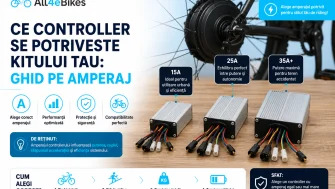
An electric bike motor works together with three essential parts: the battery (the energy source), the controller (regulates the current sent to the motor) and the pedal assist sensor (PAS) or throttle (decides when and how much assist you get). In All4eBikes conversion kits, the motor wheel, controller, display, PAS sensor and throttle come together in a single package, ready to install; the battery and charger are chosen separately.
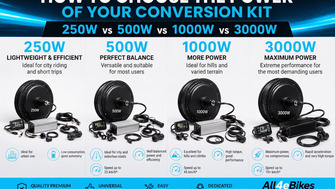
All4eBikes kits come in six power steps. The 250W kit delivers 20 N.m of torque with assist limited to 25 km/h: discreet help, low consumption, ideal on flat roads. From 500W upwards both torque and top speed climb, from 30 N.m up to 110 N.m on the 3000W kit, and from 35 km/h up to over 80 km/h. The table below helps you pick the right step for your terrain and load.
Main types of electric bike motors
There are two main motor families, split by where they sit on the bike, plus a third distinction based on the internal mechanism:
Rear Hub Motor
Built into the rear wheel's hub. Good traction, the most common type on conversion kits, relatively simple to install.
For a detailed breakdown of front vs. rear hub position, see front hub motor vs rear hub motor. For the difference between hub and mid-drive motors, including cost, maintenance and best-fit terrain, see hub motor vs mid-drive.
By internal mechanism, hub motors also split into geared (lighter, but with parts that wear over time) and direct-drive / gearless (no gears, force transferred magnetically straight from stator to rotor — heavier, but silent and virtually wear-free). All All4eBikes kits use brushless gearless direct-drive motors, reaching up to ~90.5% efficiency on the 3000W version.
What power electric bike motor you actually need
Motor power determines top speed, available torque on climbs, and the type of terrain you can comfortably handle:
| Motor power | Best for | Torque and top speed |
|---|---|---|
| 250W | Urban commuting, flat roads, discreet assist | 20 N.m, assist limited to 25 km/h |
| 500W | Suburban riding, moderate 15-18% hills, normal load | 30 N.m, up to 35 km/h |
| 1000W | Cargo (30-50 kg), constant 5-20% climbs | 40 N.m, up to 50 km/h |
| 1500W-3000W | Rough terrain, long climbs, heavy loads, custom builds | 50–110 N.m, from 60 km/h to over 80 km/h |
For a step-by-step guide to picking the right power, see how to choose your conversion kit power.
Motor on your current bike (kit) or a new electric bike
You have two ways to get a working electric bike motor:
Conversion kit
- Keep the bike you already own (frame, geometry, comfort you know)
- Lower cost than buying a complete new electric bike
- Self-install in 2-3 hours, with standard tools
- Free choice of motor power (250W-3000W) and battery capacity
If you go the kit route, the installation guide walks you through the whole process step by step.
Which bikes an electric motor can be installed on
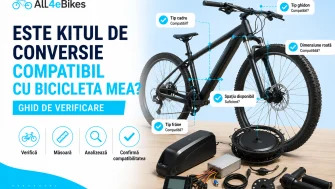
Most conversion kits are compatible with standard bikes with a 135mm quick-release rear axle — MTB, trekking and city bikes. Fat bikes usually have 170-190 mm rear spacing and only fit if the spacing is 135 mm, so measure first. Before buying, check:
- Wheel size — 26", 27.5" or 29" (availability varies by kit)
- Rear axle type — 135mm quick-release; bikes with thru-axles are not compatible with standard kits
- Brake type — disc or v-brake, both compatible with the brake levers included in most kits
Tell us what bike you have and how you plan to use it — we'll help you pick the right power and motor type, so you don't buy the wrong kit.
Ask the All4eBikes team →Frequently asked questions about electric bike motors
How much torque and speed does each kit power give you?
250W: 20 N.m, assist limited to 25 km/h. 500W: 30 N.m, up to 35 km/h. 1000W: 40 N.m, up to 50 km/h. 1500W: 50 N.m, up to 60 km/h. 2000W: 80 N.m, up to 72 km/h on 72V. 3000W: 110 N.m, over 80 km/h. Torque decides how easily you pull away and climb, while top speed also depends on battery voltage.
What's the difference between a hub motor and a mid-drive motor?
A hub motor is built into one wheel's hub (front or rear) and provides direct propulsion. A mid-drive motor is mounted centrally near the pedals and uses the bike's own gearing — better hill efficiency, but more complex to install. Full breakdown in hub motor vs mid-drive.
Can an electric motor be installed on any bike?
Most standard bikes with a 135mm quick-release rear axle are compatible — MTB, trekking and city bikes; fat bikes only if their rear spacing is 135 mm (it is usually 170-190 mm). Bikes with thru-axles are not compatible with standard conversion kits.
How long does it take to install a motor on a bike?
For hub motor kits (the most common type), installation takes 2-3 hours on average and doesn't require special tools — standard Allen keys, an adjustable wrench and a bike pump are enough.
Is an electric bike motor kit cheaper than buying a ready-made electric bike?
A conversion kit installed on a bike you already own is generally cheaper than a complete new electric bike — you only pay for the motor, battery and electronics, not the frame.
Conclusion: choose based on terrain, budget and the bike you already have
Picking the right electric bike motor comes down to three simple decisions: motor position (front hub, rear hub or mid-drive), power (250W for discreet assist, 500W-3000W for more torque and speed), and whether you keep your current bike with a conversion kit or buy a new complete one. With the specs in this guide, you have everything you need to choose correctly the first time.
See the full range of 250W-3000W conversion kits available at All4eBikes.
Reviews