


How to Choose Your Conversion Kit Power: 250W vs 500W vs 1000W vs 3000W
Motor wattage is the central decision in any bike conversion. Too little — the motor overheats on hills and limits your use case. Too much — you pay a premium for capacity you never use. This guide gives you the clear technical criteria to pick the right power for your terrain, weight, and real-world riding.
Contents
What wattage actually means on a conversion kit
The nominal wattage of a hub motor indicates the continuous power it can sustain under normal operating conditions. A 250W motor can deliver 250W continuously without risk of overheating. A 1000W motor can sustain 1000W. During short bursts of peak load (steep climbs), motors can briefly exceed their nominal rating — but nominal power is the figure used to match controller and battery compatibility.
Motor power directly determines three things: available torque (ability to climb), performance under load (rider + cargo weight), and thermal headroom (how long it can run at maximum load without overheating). It does not directly determine range — that depends on the battery.
The three factors that determine the power you need
1. Total system weight (rider + bike + cargo)
This is the most underestimated variable. At 60 kg total (light rider, lightweight bike, no cargo), 250W is sufficient for flat terrain. At 110 kg total (90 kg rider, 18 kg bike, 2 kg backpack), that same 250W motor will run near its thermal limit continuously and will throttle output on any significant incline. Always calculate your actual total weight, not just your body weight.
2. Terrain profile and maximum gradients
Gradient is the most aggressive power multiplier. On completely flat terrain, 250W is comfortable. At 10% gradient, the power demand increases by roughly 250–350W compared to flat ground, at the same weight and speed. At 20% gradient — typical for mountain trails or steep hills — the requirement exceeds 700–900W for a smooth, unforced climb. If your route regularly includes 15%+ gradients, 500W is the minimum, not 250W.
3. Frequency and duration of full-load use
A 250W motor used occasionally on gentle hills holds up fine. The same motor used daily on moderate gradients with a heavy load will accumulate residual heat cycle after cycle until the thermal protection activates and output is automatically reduced. Power headroom is not a luxury — it is long-term thermal protection. A motor that habitually runs at 70% of capacity lasts significantly longer than one that runs constantly at 95%.
250W — Silent, Lightweight, Low Consumption
Best suited for
- Predominantly flat terrain and short-to-medium daily distances
- Rider and bike totalling under 85 kg
- Occasional gradients below 8–10%, not regular
- Pedal assist priority rather than throttle-only propulsion
- Light kit (about 7 kg), 2–3 hour installation, under 60 dB in operation
- Range priority over outright performance
The 250W motor is the right pick if you want a light, silent and efficient e-bike: the kit weighs about 7 kg, installs in 2–3 hours and its assist is limited to 25 km/h. If your total weight is under 85 kg and the terrain is mostly flat, 250W is the correct choice.
Don't underestimate a well-configured 250W system: running on 48V with a 17A controller, the kit delivers ~816W peak power at startup — enough for smooth acceleration and effective assist on gentle inclines. The limitation shows on 12%+ gradients with heavy loads, or during sustained high-demand riding.
500W — Mixed Terrain, Moderate Hills, Greater Comfort
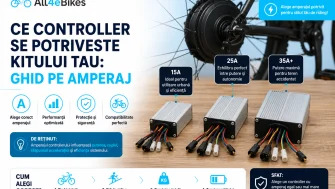
Stepping from 250W to 500W moves the controller from 17A to 22A — a significant jump in real torque at startup and on climbs. A 500W motor on a 22A controller with a 48V battery produces a peak of ~1056W, enough to handle 15% gradients with a 90 kg rider without pushing the motor into thermal stress.
If you live in a city with noticeable elevation changes or if your total system weight exceeds 85 kg, go straight to 500W rather than 250W. The price difference is minimal while the comfort margin and motor longevity are meaningfully better.
1000W — Real Performance, Steep Climbs, Rough Terrain
The 1000W kit is where performance becomes genuinely uncompromised. A 25A controller on a 48V battery produces a peak of ~1200W — enough to climb any reasonable gradient at full load without the motor approaching its thermal ceiling under normal use.
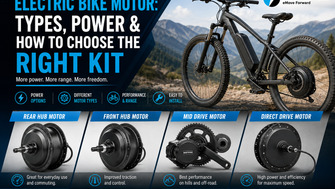
At this power level, the rear hub motor is the only technically viable option. Front wheel motors are structurally limited to 500W — at 1000W, the torque would damage the front fork on most bicycles. All six kits in the MTX range use rear hub motors for precisely this reason.
1500W, 2000W, 3000W — Extreme Power and Maximum Torque
Best suited for
- Gradients of 25–40% on technical terrain
- Total system weight of 130–200 kg (cargo, trailers)
- Extreme performance builds
- Continuous intensive use at maximum load
- 48V or 52V battery on the 1500W kit; 48V up to 72V on the 2000W and 3000W kits (60V or 72V recommended at 3000W)
- Maximum torque from 50 N.m (1500W) up to 110 N.m (3000W)
The 1500W, 2000W, and 3000W kits are not simply "more powerful" — they are a different category of product. At 3000W, the 60A controller with 18 MOSFETs produces ~110 Nm of torque directly at the wheel, with no gears and no mechanical losses. The ~90.5% motor efficiency means nearly all battery energy converts to forward motion rather than heat.
The 3000W kit accepts batteries from 48V up to 72V; for optimal performance we recommend 60V or 72V (the over-80 km/h top speed is reached at 72V). It will run on 48V, but the controller cannot deliver the full 60A at that voltage, so real-world output will be proportionally lower. If you already have a 48V battery and are considering 3000W, factor the battery replacement into your total budget.
The 1500W and 2000W kits occupy a rational middle ground: more torque than 1000W, still compatible with 48V or 52V batteries, no immediate need to replace your pack if you already have one at that voltage.
Full comparison: all power levels side by side
| Criteria | 250W | 500W | 1000W | 1500–3000W |
|---|---|---|---|---|
| Flat terrain | ✓ Excellent | ✓ Excellent | ✓ Excellent | ✓ Excellent |
| 8–12% gradients | Acceptable (<85 kg) | ✓ Good | ✓ Excellent | ✓ Excellent |
| 15–20% gradients | ✗ Insufficient | Acceptable (<90 kg) | ✓ Good | ✓ Excellent |
| 20–30%+ gradients | ✗ No | ✗ Insufficient | Acceptable (good battery) | ✓ Built for this |
| Rough, technical terrain | ✗ Not recommended | Limited | ✓ Capable | ✓ Excellent |
| Max. recommended total weight | ~85 kg | ~110 kg | ~140 kg | 200 kg+ |
| Battery voltage required | 36V / 48V | 36V / 48V / 52V | 36V / 48V / 52V | 48V / 52V / 60V / 72V |
| Included controller (MOSFETs / Amps) | 6 MOSFET / 17A | 18 MOSFET / 22A | 18 MOSFET / 25A | 18 MOSFET / 60A |
| Max. torque (official specs) | 20 N.m | 30 N.m | 40 N.m | 50 N.m (1500W) – 110 N.m (3000W) |
| Current price | Check → | Check → | Check → | Check → |
Decision tool: which kit for your situation
Your situation → Recommended power
All MTX kits available at all4ebikes.com
The complete range of rear hub motor conversion kits, in stock, with free delivery across Romania on orders over 500 RON:
| MTX Kit | Controller | Battery voltage | Recommended terrain | Price |
|---|---|---|---|---|
| 250W MTX Kit | 17A / 6 MOSFET | 36V / 48V | Flat terrain | Check price → |
| 500W MTX Kit | 22A / 18 MOSFET | 36V / 48V / 52V | Mixed terrain | Check price → |
| 1000W MTX Kit | 25A / 18 MOSFET | 36V / 48V / 52V | Hills / Rough terrain | Check price → |
| 1500W MTX Kit | 35A / 18 MOSFET | 48V / 52V | Steep climbs | Check price → |
| 2000W MTX Kit | 45A / 18 MOSFET | 48V / 52V / 60V / 72V | Cargo / Big hills | Check price → |
| 3000W MTX Kit | 60A / 18 MOSFET | 48V / 52V / 60V / 72V | Extreme | Check price → |
Tell us your weight, typical terrain, and what bike you have. We'll recommend the right kit within 24 hours. All kits are in stock with free delivery in Romania and a 24-month motor warranty (12 months on the other components).
Browse all kits → Send us your question →Battery: what changes as power increases
Motor power and battery voltage are interdependent. You cannot fit a 3000W kit to a 36V battery: its 60A controller only accepts 48V up to 72V. Higher voltage increases the real available power output.
Practical voltage-to-kit compatibility guide:
- 250W – 500W: 36V or 48V battery, both compatible
- 1000W: 48V or 52V recommended for full performance
- 1500W: 48V or 52V; 2000W: 48V up to 72V, 52V or 60V recommended
- 3000W: 60V or 72V battery — 48V works but limits real output
If you are planning a power upgrade in the future, choose a battery with the voltage suited to your final target kit from the start. A 52V battery is compatible with the 500W to 3000W kits and leaves the door open for a motor upgrade without replacing the battery.
Frequently asked questions
Which kit power should I choose for my weight and hills?
Start from your total weight (rider + bike + cargo) and the steepest gradient you climb regularly: 250W for flat terrain and under 85 kg total, 500W for moderate hills and 85–110 kg, 1000W for 15–20% gradients and 110–150 kg, and 1500W or more for very heavy loads and steep climbs. Use the decision tool above or ask us for a personal recommendation.
Can a 250W conversion kit handle hills?
A 250W kit can climb gradients up to 8–10% under normal conditions (75 kg rider, 15 kg bike, low speed). On 15%+ gradients or with additional load, the motor will be thermally stressed and will reduce output or cut out. For regular 10%+ gradients, 500W is the recommended minimum. For 20%+ gradients or heavy loads, 1000W or more.
Do I need to change my battery if I upgrade to a more powerful kit?
It depends on voltage, not wattage alone. 250W–1000W kits run on 36V or 48V — an existing 48V battery is compatible with any motor in this range. 1500W–2000W kits need at least 48V but prefer 52V. 3000W kits perform best on 60V or 72V. If you have a 48V battery, upgrading to 1000W is a direct swap with no battery change required.
How important is rider weight when choosing kit power?
Total system weight (rider + bike + cargo) is one of the most critical factors. At 60–70 kg total, 250W is sufficient for flat terrain. At 90–100 kg total, 500W becomes the recommended minimum for comfort. Above 110 kg total or with cargo loads, 1000W provides the necessary power margin. The heavier the total load and the steeper the gradient, the more power you need.
Can I start with 250W and upgrade to 1000W later?
Yes, technically possible — the motor, controller, and display are replaced as a complete new kit. Check your existing battery voltage first (250W and 1000W are both compatible with 48V, so the upgrade is direct if you have a 48V pack). The total cost of upgrading later is higher than buying the right power upfront, so we recommend choosing the power you'll need long-term from day one.
Conclusion
Motor wattage is not a marketing number — it is a technical specification with direct impact on motor safety, climbing comfort, and the long-term lifespan of your conversion. The right choice is not the highest available power, but the power that matches your total system weight, the maximum gradient you climb regularly, and your actual daily use pattern.
Flat terrain and under 85 kg total: 250W. Hilly terrain or 85–110 kg: 500W. Hills or heavy load: 1000W. Maximum torque without compromise: 3000W.
The full range is available with free delivery across Romania. Questions about compatibility with your specific bike? Get in touch or start from our beginner's guide to the eBike conversion kit market in Romania for the full picture on kit types, installation and battery selection.
Reviews