


The eBike Conversion Kit Market in Romania: Beginner’s Guide
You have a good bicycle and want to add electric assist without buying a new eBike? Conversion with a kit is the solution. This guide explains everything a beginner needs to know: what a kit includes, what types are available, how to choose power and battery, what a conversion actually costs, and where to go next for the details that matter for your specific bike.
Contents
What is an eBike conversion kit
An eBike conversion kit is a set of components that transforms your standard bicycle into a pedal-assisted electric bike. It doesn’t replace the propulsion — it adds electric assistance proportional to your pedalling effort. The result: you go further, more easily, with the same physical effort.
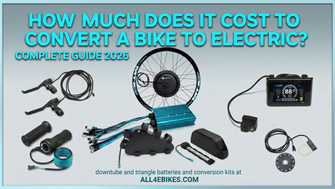
A complete kit includes:
- Brushless hub motor integrated into the rear wheel hub — the original rear wheel is replaced with this motorised wheel
- Electronic controller — regulates current to the motor based on the PAS command
- LCD display (SW900) — shows speed, battery level, PAS level, distance
- PAS sensor — detects pedalling and triggers the assist
- Throttle — direct propulsion without pedalling (optional use)
- Wiring and mounting hardware
The battery is the only item purchased separately, allowing you to choose the capacity that matches your actual usage pattern. This guide is the starting point for the whole beginner cluster on our blog — every section below links out to a dedicated, more detailed article once you're ready to dig into that specific decision.
Kit types: 250W to 3000W
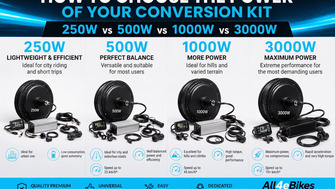
The All4eBikes range covers six power levels, each with distinct use cases:
A 250W kit with assist limited to 25 km/h. Silent and easy to install, suited to flat terrain and riders under 85 kg. View 250W →
Mixed terrain, moderate hills, 75–100 kg rider. The most balanced for varied daily use. View 500W →
Performance builds, maximum torque, heavy loads. 1500W, 2000W and 3000W kits available, with torque from 50 N.m up to 110 N.m. View all →
Picking the right wattage from this list is the single most consequential decision in the whole process — get it right and the bike matches your terrain and weight for years; get it wrong and you either overheat a motor or overpay for capacity you never use. We cover the full decision logic, torque figures and a step-by-step tool further down, and in more depth in how to choose your conversion kit power.
DIY conversion vs buying a new eBike
The common question: wouldn’t it be simpler to just buy a ready-made eBike? The answer depends on your situation:
The major advantage of conversion: you keep the bike you know — its geometry, comfort, drivetrain. You only add electric assist without changing the character of the bicycle.
What the MTX All4eBikes kit includes
Every kit in the MTX range comes fully equipped — no additional purchases are needed beyond the battery:
- Brushless gearless hub motor with complete rear wheel (rim, spokes, motor hub)
- Electronic controller (amperage matched to kit power)
- Wheel sprocket (included in the package, fitted during installation)
- SW900 LCD display with large screen and all displayed functions
- PAS sensor (mounts at the bottom bracket)
- Twist throttle
- Sensor brake levers with motor cut-off
- Two torque arms with clamps
- All cables and connectors for complete installation
The battery range available separately covers voltages 36V, 48V, 52V and 72V in downtube and triangle formats. Getting the battery right — not just the kit — is what actually determines how far you'll ride and how the motor performs under load, which is why we've dedicated a full section to it below.
What to look for in a quality kit
- Brushless (BLDC) motor with permanent magnets — not a brushed motor that wears out
- Controller with quality MOSFETs — resistant to overheating and overcurrent
- Display-controller communication — enables advanced settings and diagnostic error codes
- PAS sensor compatibility — smooth, gradual assist rather than jerky engagement
- Correct dropout and axle width — confirm your frame's rear dropout (135mm QR is the standard on most bikes) matches the kit before ordering
- Freewheel compatibility — MTX motor wheels take a threaded 7-speed freewheel (1.375" x 24 TPI), included in the kit; 8 to 12-speed cassettes cannot be moved across, so plan on a 7-speed drivetrain
- Warranty and technical support — essential if problems arise during installation or use
If you're not sure your specific bike qualifies on all these points, read the full compatibility verification guide before you order — it walks through wheel size, axle type, brake type and frame clearance in detail.
How much motor power do you actually need?
The biggest decision after "should I convert" is "which wattage." Power determines torque on hills, how the motor handles your weight plus any cargo, and how much thermal headroom you have on long climbs. Getting this wrong in either direction is the most common beginner regret: too little power and the motor labours and overheats on inclines; too much and you're paying for capacity you rarely use.
As a rough starting point: 250W suits flat terrain under about 85 kg total system weight, with assist limited to 25 km/h. 500W is the balanced choice for mixed terrain and moderate hills up to roughly 110 kg. 1000W and above is for regular climbs, rough trails, cargo loads or heavier riders, and 1500–3000W kits deliver maximum torque, from 50 N.m up to 110 N.m, for the heaviest loads and steepest climbs. For the full breakdown of torque figures, controller amperage and a decision tool matched to your exact terrain and weight, read our complete guide to choosing your conversion kit power.
Choosing the right battery for your kit
Picking the correct e-bike battery is arguably the decision beginners get wrong most often — not because it's technically difficult, but because it's easy to focus only on price and overlook voltage matching, BMS current, and real-world range. MTX kits accept different battery voltages depending on power (250W: 36V or 48V; 500W and 1000W: 36V, 48V or 52V; 1500W: 48V or 52V; 2000W and 3000W: 48V up to 72V), so the battery voltage is not optional: it has to sit within your kit controller's range.
Capacity (Ah) is where the real decision happens. A 10–13Ah battery is light, affordable and charges in around 5–6 hours — a solid match for a 250W or 500W kit and daily distances under 40 km. A 17–25Ah battery is heavier and costs more but delivers 55–100+ km of range and a BMS rated for the higher sustained current a 1000W+ kit draws. Our dedicated guide walks through the full voltage, watt-hour and BMS-current math with a kit-by-kit recommendation table: how to choose your battery — 10Ah vs 20Ah.
Once you're riding, two more battery questions come up quickly: how far will it actually get you day to day, and how long will the pack last before it needs replacing. Both are covered in detail in real-world e-bike range explained and e-bike battery lifespan and maintenance.
What does a conversion actually cost?
Total cost has two main components: the kit itself (motor, controller, display, PAS sensor and throttle are all included) and the battery, purchased separately. A basic setup — 250W kit plus a compact 36V battery — is the most affordable entry point and suits flat terrain. A standard setup — 500W kit plus a 48V 17.5Ah battery — is the most common choice, balancing power, range and price for the widest range of riders. A performance setup — 1000W kit plus a larger 48V battery, sometimes with a controller upgrade — costs more but handles hills, cargo and heavier riders without compromise.
Running costs matter too: charging a modern lithium e-bike battery costs a small fraction of fuel for an equivalent distance, and the electricity cost per charge scales with pack size, not motor power. For exact figures and a full scenario-by-scenario cost breakdown, see how much does it cost to convert a bike to electric and how much does it cost to charge an e-bike battery. Prices change frequently, so always check the current product page before finalising your budget.
Cargo loads, fat bikes and heavy-duty conversions
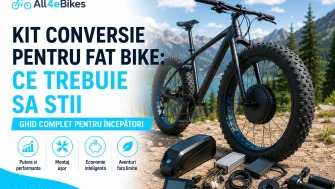
Not every conversion is a lightweight setup. If you're converting a fat bike for snow, sand or loose gravel, the wider tyre, different fork clearance and lower rolling efficiency change which kit and power level actually make sense — a straightforward 250W setup that works fine on a road bike often struggles on 4-inch tyres in soft terrain. Our dedicated guide covers exactly what to check before ordering: conversion kit for fat bikes: what you need to know.
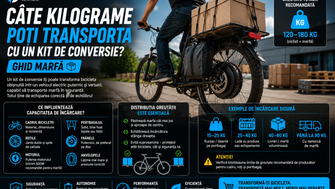
If you're planning to carry cargo — panniers, a child seat, delivery loads or camping gear — the extra weight changes your power and battery math in the same way a heavier rider does: more torque needed on hills, faster battery drain, and more stress on the motor and axle. Before you commit to a kit, it's worth understanding exactly how much load your setup can realistically carry without shortening component lifespan: how much cargo can your conversion kit handle.
Range and daily riding: what to actually expect
Range numbers on paper rarely match real-world riding. Wind, elevation, tyre pressure, rider weight, temperature and how much you rely on the throttle versus pedal assist can all shift range by 30% or more compared to a lab figure. Before you plan your rides around a specific number, it's worth reading how range is actually measured and what realistic figures look like kit by kit: real-world e-bike range explained.
If you ride every day, the day-to-day questions are different from a weekend ride: can you charge at work, how does cold weather affect your morning range, and how much faster is a converted bike than your current ride. We cover all of this, including realistic weekly cost and time comparisons, in daily e-bike riding.
Prefer a ready-made e-bike instead? The DUOTTS range
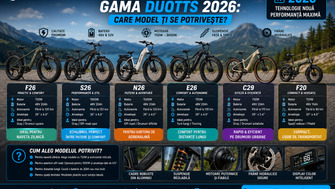
If, after reading this guide, you decide a DIY conversion isn't for you — perhaps your current bike isn't worth converting, or you'd rather have a single-source warranty — all4ebikes.com also stocks complete, ready-to-ride DUOTTS electric bikes, from lightweight 250W city models to 750W+ e-MTBs with Bafang mid-drive motors. Every model comes fully assembled with an integrated battery, no installation required. See the full lineup, specs and use cases in the complete DUOTTS 2026 range guide.
First steps: from zero to eBike
- Verify bike compatibility: wheel size (26", 27.5", 29"), axle type (QR 135mm), brake type. Compatibility guide →
- Choose your kit power based on terrain, weight and usage: 250W for flat terrain, 500W for mixed terrain, 1000W+ for hills and cargo. See the power guide →
- Choose your battery based on the voltage your kit accepts (36V to 72V depending on power; see each kit page) and desired range. More Ah = further range per charge. See the battery guide →
- Order your kit and battery — free delivery in Romania on orders over 500 RON; warranty of 24 months on the kit motor and 12 months on the other components and on batteries.
- Install in 2–3 hours with standard tools. Follow the detailed installation guide on the blog.
- First ride and configuration — set the voltage (P03) and wheel size (P06) in the display, choose your preferred PAS level and enjoy.
Common mistakes first-time converters make
- Guessing wheel size and axle width instead of measuring. Ordering the wrong hub motor size is the single most common — and most expensive — beginner mistake. Measure your rim diameter and rear dropout width before ordering.
- Buying the biggest battery "just in case." Oversized batteries add unnecessary weight and cost without improving your actual daily range if your daily distance is short. Match capacity to real usage, not worst-case fantasy.
- Ignoring the BMS current rating. A battery with the right Ah but an undersized BMS will cut out under load on hills or hard acceleration — exactly when you need power most.
- Leaving the torque arms loose. Every kit includes two torque arms with clamps. Fit both and tighten them firmly: motor torque can otherwise loosen or spin the axle in the dropout over time.
- Not checking brake compatibility before ordering. Rim brakes, mechanical disc and hydraulic disc all mount differently — confirm which sensor brake levers your kit ships with match your existing setup, or budget for a swap.
- Underestimating total system weight. Rider weight alone isn't the full picture — add the bike, any cargo, and your typical luggage. This total is what actually determines whether 250W is enough or you need 500W+.
- Assuming installation needs a bike shop. Most hub motor kits install in 2–3 hours with basic tools. Budgeting for professional installation you don't need adds cost for no benefit.
Tell us your bike type, wheel size, typical route and your weight — we’ll recommend the right kit and battery within 24 hours, at no extra cost.
Get a free recommendation → Browse kits →Frequently asked questions
What is an eBike conversion kit?
An eBike conversion kit is a set of components that transforms a standard bicycle into a pedal-assisted electric bike. The kit includes the hub motor with the rear wheel, the controller, the LCD display, the PAS sensor and the throttle. The battery is purchased separately as the optimal capacity depends on motor power and desired range.
How long does installation take?
On a first install, a hub motor kit takes 2–3 hours with standard bicycle tools: Allen keys, an adjustable spanner and a pump. No specialist tools or authorised workshop required. All4eBikes provides a detailed step-by-step installation guide on the blog.
Which kit power should I choose as a beginner?
250W suits flat terrain under about 85 kg total weight, and 500W is the balanced choice for mixed terrain and moderate hills up to roughly 110 kg. Go for 1000W or more only if you have frequent hills, cargo or a heavier rider. The power guide has a decision tool matched to your weight and terrain.
What is included in an All4eBikes conversion kit?
Every MTX All4eBikes kit includes: the hub motor with the complete rear wheel, the electronic controller, the SW900 LCD display, the PAS sensor, a twist throttle, two torque arms with clamps, the wheel sprocket and all wiring and mounting hardware. The battery is the only item purchased separately, as the optimal capacity depends on motor power and desired range.
How much does a full conversion cost, including the battery?
Total cost depends on the motor power and battery capacity you choose — a basic 250W setup with a compact battery is the most affordable entry point, while a 1000W setup with a large battery and optional upgrades costs considerably more. See the full scenario-by-scenario breakdown in our conversion cost guide, and check current prices on the product pages since they update regularly.
Can I convert a fat bike or a bike I use for cargo?
Yes, but wider tyres, cargo loads and heavier total system weight all change which power level and battery capacity actually make sense. Read our guides on fat bike conversions and cargo capacity before ordering, since a setup that's fine for a lightweight road bike can be undersized for a heavier build.
How far will my converted e-bike actually go on one charge?
It depends on your battery's watt-hours, motor power, terrain, rider weight and how much throttle versus pedal assist you use — real-world range is typically 20–30% lower than lab figures. Our real-world range guide breaks down realistic figures per kit and battery combination.
How much does it cost to charge an e-bike battery?
Charging a lithium e-bike battery costs a small fraction of the price of fuel for an equivalent distance, and the cost scales with battery size (Wh) rather than motor power. See the exact calculation and typical monthly cost for daily riders in how much does it cost to charge an e-bike battery.
What if I don't want to install a kit myself?
In Bucharest, All4eBikes fits kits bought from us at our Sector 4 location in 2–3 hours, by prior appointment on WhatsApp at 0773 949 024. All4eBikes also sells complete, ready-to-ride DUOTTS electric bikes that need no installation, from 250W city models to 750W+ e-MTBs. See the full lineup in the complete DUOTTS 2026 range guide.
Reviews