


How Much Cargo Can Your Conversion Kit Handle? Load Limits
Want to carry groceries, tools or cargo with your electric bike? We show you what motor power and setup you need based on the extra weight you plan to carry.
Contents
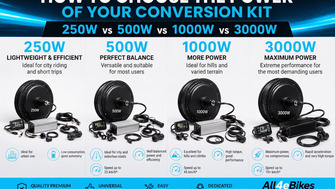
Weight limits by wattage
There's no universal "legal" weight limit for a conversion kit, but there are practical limits beyond which performance and component lifespan start to suffer:
| Kit power | Recommended extra cargo | Typical use |
|---|---|---|
| 250W | 5-10 kg | Light commuting, small groceries |
| 500W | 10-15 kg | Commuting with luggage, regular groceries |
| 1000W | 15-25 kg | Light cargo, tools, equipment |
| 1500W | 25-35 kg | Regular cargo, hilly terrain |
| 2000W | 35-50 kg | Heavy cargo, commercial use |
| 3000W | 50+ kg | Extreme cargo, rough terrain with load |
See all kits and current prices →
Which kit to choose for cargo and commercial use
For frequent cargo transport, we recommend going with at least 1000W, ideally 1500W or 2000W, combined with:
- A high-capacity battery (over 20Ah) for enough range with extra cargo — see how to calculate real-world range
- A high-amperage controller for enough torque to start from a standstill with a heavy load
- Both torque arms supplied with every MTX kit, fitted from day one — nearly mandatory at these power levels (the separate torque arm set is for replacement)
Why a torque arm becomes essential under heavy load
Under heavy load, the force applied to the motor axle increases significantly, and the risk of the axle spinning in the frame's dropouts (a phenomenon called "spun axle") rises proportionally. A torque arm distributes this force and prevents damage to the frame or axle — essential if you regularly carry over 20-25 kg of extra cargo. Every MTX kit ships with two torque arms; make sure both are fitted and tight (a spare torque arm set is sold separately).
Signs both torque arms must be fitted and checked
- You regularly carry over 20 kg of extra cargo
- You have a 1000W or more powerful motor
- You notice slight play or movement of the axle in the dropout
Real-world cargo scenarios: matching power to your actual load
Wattage tables are useful, but they become far more concrete once you map them to how people actually use a cargo-loaded e-bike day to day. Below are four common scenarios we see from All4eBikes customers, each with a realistic weight range and the kit power that keeps performance and component wear in check.
The weekly grocery run (5-15 kg)
Two or three shopping bags, a rider of average weight, mostly flat urban terrain. This is the lightest cargo scenario and the one where a 250W kit is genuinely enough — you'll notice a small drop in acceleration from a standstill with full bags on the rack, but nothing that affects safety or component life. If your route includes a steep hill on the way home, step up to 500W for a more comfortable margin.
The daily food delivery rider (15-30 kg, multiple stops)
Insulated delivery bags plus repeated stop-start riding put more cumulative strain on a motor than a single heavy grocery run, because the motor works hardest during acceleration from zero. For this pattern, we recommend at least 1000W, and riders doing 6-8 hour shifts should budget for a larger-capacity battery so range doesn't become the limiting factor before the shift ends.
The cargo bike parent (20-40 kg of kids and gear)
Carrying one or two children plus bags, on a longtail or front-loader cargo frame, is one of the heavier day-to-day scenarios because the weight is concentrated and often high off the ground, which affects handling as much as raw power. A 1500W kit with both of its torque arms fitted gives enough low-speed control to start smoothly from a stop with kids on board, which matters more here than outright top speed.
The tradesperson hauling tools (30-50+ kg)
Toolboxes, spare parts and equipment are dense and don't shift around like groceries, but they add real weight that's carried all day, every working day. At this level we recommend 2000W or the 3000W kit for hilly routes, always with both included torque arms fitted and a high-amperage controller — running a lighter kit at its absolute limit every single day is what shortens motor and controller lifespan the fastest.
Battery capacity: the overlooked factor in cargo capability
Motor wattage gets most of the attention, but the battery is just as important for cargo use. Extra weight increases current draw at every acceleration, which drains a battery faster than the same ride unloaded — our guide to real-world range covers the math in detail, but the short version is that a heavily loaded bike can see range drop by 15-25% compared to an empty one, depending on terrain and how many stops you make.
For regular cargo use, we recommend a battery of at least 20Ah, and ideally more if your route includes hills or you don't want to charge daily. Between the two mounting formats, choose based on the space in your frame and the voltage you need, not on capacity: in our range the largest downtube battery (52V 24Ah, 1,248Wh) holds more energy than the 48V and 52V triangle batteries, and only the 72V 20Ah triangle pack (1,440Wh) goes higher. See our 10Ah vs 20Ah battery comparison for a closer look at how capacity translates into real range.
Braking and control under load
Extra weight doesn't just affect acceleration — it increases stopping distance too, sometimes significantly. A bike that carries an extra 30-40 kg needs meaningfully more distance to stop at the same speed than the same bike unloaded, simply because there's more momentum to dissipate through the same brake pads and rotors.
If you're regularly riding loaded, a few practical habits go a long way: brake earlier and more progressively rather than braking hard and late, check pad wear more often than you would on an unloaded bike, and if your current setup uses rim brakes, seriously consider upgrading to hydraulic disc brakes, which handle heat and repeated hard stops far better under sustained cargo use. On long descents with a full load, feather both brakes together rather than relying on the rear brake alone, which can overheat and fade faster when it's doing most of the work.
Frame, tires and suspension under heavy load
The motor and battery aren't the only components under extra stress when you add cargo — the frame, tires and suspension all feel it too. A well-built steel or reinforced aluminum frame handles sustained cargo weight better than a lightweight frame designed purely for unloaded commuting; if you're building a dedicated cargo setup from a donor bike, check the manufacturer's stated maximum total weight (rider plus cargo) before committing to a high-power kit that could exceed what the frame was designed to carry.
Tire pressure matters more under load than most riders expect: under-inflated tires flex more, increase rolling resistance, and are more prone to pinch flats when you hit a pothole with extra weight on board. Run tire pressure toward the higher end of the manufacturer's recommended range when carrying regular cargo, and consider slightly wider tires if your frame allows it, for a larger contact patch and more stability. If your bike has a suspension fork, heavier loads can cause it to sag more and bottom out over bumps more easily — many riders carrying regular cargo find a rigid fork, or a fork with adjustable preload, more predictable than a soft suspension fork under load.
How to calculate your own cargo needs
Rather than guessing which row of the table above applies to you, work through these four questions:
- What's your total added weight? Add up cargo weight plus anything else beyond a normal unloaded ride — panniers, a child seat, a fully stocked delivery bag.
- How often do you carry it? Occasional loads (once a week) are far less demanding on components than a load you carry on every single ride.
- What's your terrain? Add a full power tier of margin if your route includes sustained hills — a flat-terrain 1000W setup can feel underpowered on a hilly route carrying the same cargo.
- How many stops and starts? Stop-start riding (deliveries, school runs, city traffic) stresses a motor more per kilometre than steady cruising, because most of the current draw happens during acceleration from zero.
Once you have honest answers to these four questions, cross-reference them against the weight limits table above and round up rather than down if you're between two tiers — a slightly oversized kit run comfortably below its limit lasts longer than an undersized kit run at its ceiling every day.
The alternative: racks and baskets, not trailers
All4eBikes focuses on conversion kits, batteries and motor accessories — we don't sell trailers as a separate product. For extra cargo, the most practical solution remains a solid rack mounted directly on the frame, combined with baskets or panniers, which don't add the mechanical complexity of a towed trailer.
Where you mount the load matters almost as much as how much you carry. Weight placed low and centered, such as panniers either side of a rear rack, keeps the bike's handling predictable even when fully loaded. A single large basket or bag mounted high, or loaded only on one side, shifts the centre of gravity and makes the bike noticeably harder to balance at low speed — something worth testing in a quiet area before you rely on it for a real commute or delivery run. If you regularly split cargo between front and rear, aim to keep the load roughly even rather than putting most of the weight over one wheel, which improves both handling and how evenly your tires wear.
Tell us how much cargo you want to carry and how often — we'll recommend the right motor power and battery, free of charge.
Get a free recommendation →Frequently asked questions about carrying cargo
How much cargo can a bike with a conversion kit carry?
It depends on motor power: a 250-500W kit comfortably supports the rider plus 10-15 kg of extra cargo, while a 1000-3000W kit can support the rider plus 30-50 kg or more, depending on the bike frame and terrain type.
Which conversion kit do you recommend for cargo or commercial use?
For frequent, heavy loads, we recommend a minimum of 1000W, ideally 1500W or 2000W, combined with a high-capacity battery (over 20Ah) and a high-amperage controller for enough torque to start from a standstill.
Do I need a torque arm if I carry heavy loads?
Yes, even more so. The torque arm prevents the motor axle from spinning in the frame dropouts under heavy load, a real risk when carrying extra cargo on a powerful kit. Every MTX kit already includes two torque arms — fit both and check them regularly.
Does All4eBikes sell trailers for electric bikes?
All4eBikes currently focuses on conversion kits, batteries and motor accessories - we don't sell trailers as a separate product. For extra cargo, we recommend racks and baskets mounted directly on the frame.
What happens if I exceed the recommended weight for my kit?
The motor and controller work harder, which reduces range, raises component temperature, and can shorten the motor's lifespan over time. Occasionally is not a major issue, but consistently exceeding the limit is not recommended.
How does cargo weight affect my e-bike's range?
Extra weight increases current draw on every acceleration, which can reduce range by 15-25% compared to riding unloaded, depending on terrain and how many stops you make. See our guide to real-world e-bike range for the full breakdown.
Can I use a 250W kit for occasional heavy cargo?
Occasionally, yes, without major issues. The concern is consistent heavy use: running a 250W kit at its absolute limit every day accelerates wear on the motor and controller far more than the same load carried once in a while.
What's the difference between a dedicated cargo e-bike and a standard bike with a conversion kit?
A dedicated cargo frame (longtail or front-loader) is built from the ground up for load-carrying, with a lower centre of gravity and reinforced geometry. A standard bike fitted with a conversion kit can carry meaningful cargo too, provided the frame, motor power and battery are matched to the load as described above.
Conclusion: match power to your real cargo weight
Simple rule: the more cargo you carry, and the more often, the more power and battery capacity you need. For occasional groceries, 500W is enough; for regular cargo runs, go straight to 1000-1500W, with both included torque arms fitted.
Not sure what setup fits you? Contact the All4eBikes team for a free recommendation based on your actual weight and transport frequency.
If you're still weighing up a conversion kit against buying a ready-made electric bike in general, our beginner's guide to the e-bike conversion kit market in Romania covers the bigger picture before you narrow down to a specific power level.
Reviews